Sunday, September 12, 2010

The Susan G. Komen Race for Irrelevance

When I lost my father to bladder cancer at the age of 14, it seemed cruel and ironic that he managed to survive the Holocaust, only to be done in by some virulent disease that cost him his life and, while he was still living, his dignity. Even worse, in his mind, than having to choose between mind-boggling pain and the mind-numbing drugs that would alleviate his suffering, he had to suffer the iniquity of pissing through a hole in his side, something my proud father could never adjust to.

What we know now, however, is that bladder cancer isn't just some rider on the storm, a vagrant disease striking strangers in the night—my father unwittingly brought the disease upon himself by smoking two or three packs of Old Gold cigarettes every day. We all suspected, the denials of tobacco companies notwithstanding, that cigarettes caused lung cancer; we didn't know enough to understand that it also caused cancers to digestive and other crucial organs.

Which brings me to the 20th annual Susan G. Komen Race for the Cure, which this year attracted over 25,000 well-meaning people to Central Park, all of them determined and gulled into believing that their appearance will knock cancer senseless, pound it to oblivion, tear it limb from limb I tell ya'.

Okay, at least the Susan G. Komen Foundation has retreated from its Temper Tantrum for the Cure. But it's still perpetrating a massive fraud upon determined (if credulous) multitudes, which, like most frauds, is criminal not just for what it manages to accomplish—to part people from their millions—but for what it wastes, which is the opportunity to bring all those financial and human resources to bear on the real cause of cancer.

By the way, my point here isn't to prove what most sane and objective observers have come to realize—which is that cancer is mostly caused by environmental factors ranging from the crap we eat to the poison we allow corporations to pour into landfills and directly into the air and the rivers and streams that we and our livestock ingest.

No – if you don't already know that, this diatribe isn’t for you. But here's the issue: the Susan G. Komen Foundation and its ilk would have us believe that finding cures for cancer is a smart strategy, which is kind of like arguing that liposuction is a good cure for obesity.

Most people understand this, if only on an intuitive level. Cancer is inexorably on the rise, and attempting to cure cancer is akin to humanity racing itself on a galactic hamster wheel, only much more expensively. That’s good for universities and drug companies, but otherwise entirely besides the point.

You can see where I'm going, right? All this energy and all those resources should be directed against the Monsantos and Con Agras of the world, the Liggets and the Dows and the Tysons. My god, I could go on and on.

And that's the point. To confront the root causes of cancer is to politicize the debate, to point fingers at our employers and our neighbors, and to pick a side on the political debate between free markets and regulations.

(It doesn't have to be that way, of course. Free-market champions could still get on board by boycotting companies that create cancer-causing products or byproducts. But there would have to be clear-eyed and honest leadership on the right side of the political spectrum for that to happen, and that seems to be nonexistent.)

Instead of attacking the root cause of cancer, the Susan G. Komen Foundation solicits sponsorships, allowing corporations to give away tee-shirts to their employees as a show of solidarity, of support for women, as a team-building exercise (and for brand marketing – hey, there's nothing wrong with that!).

And Central Park is filled with pink-wearing, self-anointed heroes of the fight against breast cancer, choked-up women giving speeches about courage, fortitude and survival, the event every year more populous, more ritualized, more lucrative. And just as irrelevant to the real fight as the year before.

Monday, March 1, 2010

Puerile No-Government Fantasies

Here's the main problem with people who believe in allowing markets to run everything and limited government: they're just in it for themselves, and they already have a head start.

Their argument almost without exception boils down to a resentment of paying taxes so your kid can go to school.

The underlying idea is that the whole social contract thing is a crock; that government and its myriad rules and agencies have been foisted upon us unwittingly; that laws have created market dislocations that benefit the powerful industrial cabals that created government to begin with; and that if left to their own devices, people would take care of themselves quite nicely without it, thank you very much.

What separates Libertarians from Anarchists is that the former would keep a police force to enforce the peace and an army to protect the borders. Everything else would be strictly based on choice and the private sector.

Roads? Not a problem, private companies would compete for your dollars. Schools? All manner and price would emerge to serve various constituencies. Health care? Ditto. In other words, there isn't anything government does that private businesses couldn't and wouldn't do more cheaply and more effectively.

Best of all -- and this is where you see the childishness of the philosophy -- you don't have to pay for anyone else. Pay as you go, pay as you need. Save for future needs and if you don't, maybe a private charity will exist to help you out.

Or not. In which case, tough noogies.

Put aside the inanity of the argument -- the idea that we'd be better off this way, or that private companies are actually more efficient than government in every case. The real question is, how far do you roll this back? Do you actually rescind all laws? Delegitimize all levels of government, from federal statutes all the way to town ordinances? Do you sell off all government assets and redistribute the loot to the people? Do you pay off government debt first, or do you claim that those obligations were made without the consent of the people?

Or let me put it another way. Imagine we've achieved this Libertarian paradise where no laws obtain, other than the laws of the market.

Information flows easily, allowing individuals to choose goods and services in an informed manner. Consumers can take their business away from companies that pollute the rivers, maltreat animals, sell contraceptives -- you get the idea. Instead of laws regulating behavior, everyone does what they want (other than commit acts of violence) and the market punishes and rewards.

Now what happens if there's a place that needs, I don't know, a hospital, and the people in that place get together and decide to raise money to build one together and hire some people to run it for them? Would that be legal? Because that would be the beginnings of -- wait for it -- government.

So the question no Libertarian can answer is this one: if a government emerged from a Libertarian state, would it be illegal? If people of their own free will created government, would they be considered traitors? Would their community be ostracized?

Because you know that this is exactly what would happen, and it would be more successful than the puerile alternative offered by the likes of Ron Paul and his acolytes. Government wasn't actually foisted on us -- we organized it. It didn't come easily; Chicago had to burn to the ground before we realized that private sector fire departments were a really bad idea.

Yeah, government is really big and messy and complicated -- which is as it should be, since our country is really big and messy and complicated. Libertarian philosophy is at best nothing more than an infantile yearning for a simpler, more bucolic, prelapserian epoch, a wish to evade the complexity and trade-offs that grown-ups have to make every day. (At worst, it's a craven attempt to avoid paying taxes.)

I "wish" I didn't have to pay taxes too, but I also "wish" I could live forever. You don't have to share the vision of the author Claude Meunier, who once told me, "I enjoy paying taxes because it reminds me that I live in a civilized country," to understand that we really are inseparable and united by common needs.

Separateness is a fantasy in which we indulge ourselves. But just as we can't quarantine ourselves against diseases that are a plane ride away, we can't segregate our needs from those of our compatriots and refuse the very notion of a common weal.

Thursday, February 25, 2010

Obama Should Steamroll the GOP on Health Reform

There's a lot of hand-wringing about whether the Democrats and Barack Obama should use reconciliation as a way of passing health care reform (HCR) in the face of the GOP filibuster.

Newt Gingrich actually had the chutzpah to call it "majoritarianism," as if a two-thirds majority had actually been written into the U.S. Constitution.

But most of the hand-wringing is actually coming from the left, which worries that Obama and the Democrats will suffer political consequences -- tea party madness, populist revolt, etc. -- in November.

That's madness. They will suffer consequences for not doing everything in their power to pass the HCR we elected them to enact.

This Princeton Survey Research poll conducted for Newsweek proves a couple of important points:

  • Obama has way more political capital than the GOP
  • Obama has let the GOP frame HCR in a way that makes it less popular
  • People are overwhelmingly in favor of most aspects of the plan and -- this is the key --
  • Rate Obama's plan favorably when they're told what those proposals really are, even though there are aspects of the reform that they don't like.

Here are some of the poll questions and results:

First of all, Obama is popular. His health care favorables are bad, but still better than the GOP:

Do you approve or disapprove of the way Barack Obama is handling his job as president?

48 Approve
40 Disapprove
12 Don’t know


Now thinking about the issue of HEALTH CARE REFORM… Please tell me if you approve or disapprove of the way each of the following is handling this issue. (First,) do you approve or disapprove of the way
Approve Disapprove DK
a. Barack Obama 39 52 9
b. GOP in Congress 21 63 16
c. Dems in Congress 27 61 12


On an up-and-down, blind test, Obama's HCR is unpopular

As you may know, Barack Obama has proposed a plan to change this country’s health care system. From what you have seen or heard about what he has proposed, what is your OVERALL opinion of Obama’s health care reform
plan – do you favor it or oppose it?
Favor Oppose DK
40 49 11


But when the proposals are spelled out, people love pretty much all of them:

Do you favor or oppose this proposal (to change the health care system)?

a. Requiring that all Americans have health insurance, with the government providing financial help to those who can’t afford it

Favor Oppose DK
59 36 5

b. Requiring most businesses to offer health insurance to their employees, with tax incentives for small business owners to do so
Favor Oppose DK
75 20 5

c. If health coverage is required for everyone, imposing fines on individuals who don’t obtain
coverage and on larger businesses that don’t offer it
Favor Oppose DK
28 62 10

d. Requiring health insurance companies to cover anyone who applies, even if they have a pre-existing medical condition
Favor Oppose DK
76 19 5

e. Creating a government-administered public health insurance option to compete with private plans

Favor Oppose DK
50 42 8

f. Creating a new insurance marketplace – the Exchange – that allows people without health
insurance to compare plans and buy insurance at competitive rates

Favor Oppose DK
81 13 6

g. Preventing insurance companies from dropping coverage when people are sick

Favor Oppose DK
59 38 3

h. Imposing a tax on insurers who offer the most expensive health plans, the so-called Cadillac plans, to help pay for health care reform

Favor Oppose DK
34 55 11


The fascinating thing is, when people are told this is part of Obama's HCR plan, they change their tune about it:

Now please think about the proposals I just described to you. ALL of these proposals are included in Barack Obama’s health care reform plan. Having heard these details, what is your OVERALL opinion of Obama’s plan – do you favor it or oppose it?
Favor Oppose DK
48 43 9

Now tell me people are going to hold his use of a parliamentary procedure against him if that's what it takes to get a bill passed. On the contrary, they'll love him for doing it, as long as he and the Democrats spend enough time touting its benefits.

Saturday, February 20, 2010

The Hudson Manifesto

In an age of Manifestos, it is only appropriate to name this Manifesto after the river first used by Europeans to penetrate into the American Continent more deeply than ever before, and around the banks of which two men who created the American conception of government as a means of seeding innovation, sustaining business, protecting individual liberty and advancing the cause of economic and social freedom, Alexander Hamilton and Franklin Delano Roosevelt, first forged their philosophies and their reputations.

For those of us who pledge our names to this Manifesto, government is the extension of the political will of the people who elect it; it is a means of creating the conditions for economic growth while protecting the liberties of men and women who would be crushed by the onslaught of an economic engine unfettered by any moral compass; it is the means by which men and women in a free society arbitrate their grievances, agree to rules of conduct in the marketplace and the public square, and alternately allocate and protect the resources we find on our land.

Because our nation has grown to more than 300 million inhabitants, from hundreds of cultures, for more than 200 years, it is natural and necessary that the government we have created be big and complex.

Our federal government in particular has had a role in fostering western expansion, the creation of a national transportation grid (first rails, then roads), a national electrical grid, and a national banking system.

Our federal government protects individuals from large corporations who would otherwise collude together to maintain high prices, pay low wages, pollute water and air, and produce unclean and unsafe goods and food with impunity.

Our federal government protects individuals from the tyranny of the majority, from discrimination on the basis of religious affiliation, color and gender.

Our federal government provides for, and should do more, to ensure that its citizens have access to minimum food and shelter, education and health care.

Our federal government cannot be scaled down to a size that ignores the consequences of more than 200 years of accumulation and distribution of wealth, most of it unequal. It cannot ignore the needs of children born into conditions from which they cannot reasonably be expected to rise without some help, nor the needs of those afflicted with natural disasters, nor fail to continue to act as a bulwark for individuals who, alone, cannot compete against the power and interests of corporations.

Our government must remain big and complex, and it must continue to grow, so that it can continue in the tradition of the agencies that supported the emancipation of African Americans and women, the harnessing of scientific research and the creation of common infrastructure necessary to the creation of individual wealth.

Thursday, February 11, 2010

Obama's Driving Issue


President Barack Obama's biggest issue isn't untangling government from private businesses like Citigroup or, more pertinently, General Motors. No, his biggest problem, and the country's as a whole, is his having to use both arms to swat aside gadflies bent on scoring political points at the expense of the greater good.

The governors of four states that depend heavily on Toyota for jobs are accusing the Administration of having a "conflict of interest" in its efforts to protect U.S. consumers from callous treatment at the hands of the Japanese auto maker.

Never mind that the

National Highway Traffic Safety Administration had to compel Toyota to halt the sale of 8 models on Jan. 26 as the automaker sought a fix for reports of sticky pedals. U.S. Transportation Secretary Ray LaHood said last week that "every step of the way" NHTSA had to prod Toyota into acting.

Sunday, February 7, 2010

Very Well, Thanks, Sarah Palin


Will you ever go away? Will you never leave us alone for even a little while? When will you understand that we really meant it when we said, "no, not you?"

Even racists voted for Barack Obama, because even they could see that you are a walking disaster. Republicans walked away from you because you scared them so badly. You're ignorant and, what's worse, you're proud of it.

Thing is, no one wants to see the country run by a woman who got herself elected high school Homecoming Queen by virtue of being mean-spirited and vindictive. It's just that simple.

As a recap, Sarah, you lost in November 2008 by the largest margin ever posted by a non-incumbent, and, in case you hadn't noticed, you haven't become much more likable or electable since. More than 70% of Americans don't even want you to run for President. Media companies may pay you to appear on their shows and magazine covers, but apparently not that many people will pay to hear you speak.

And with good reason. Most of us are pretty happy with our "hopey, changy stuff." It's a lot better than "you're doing a heck of a job," "stay the course,"and "privatize social security," even among those who don't live on the coasts, consider themselves liberals, drink lattes, or pal around with terrorists.

Speaking of which, we're quite happy, thank you very much, that we're no longer international pariahs, that our President speaks coherently, and in complete sentences, and is actually trying to change things. It's a hopeful sign for our country, if you get my drift.

And yes, it's been frustratingly slow going, due in large part (but not exclusively so) to the Party of No, which has now gone so far as to block all the President's appointees, including someone to head the TSA, for reasons ranging from petty to purely obstructionist.

America First, by all means.

So here's a heads up, Sarah: you guys lost. You don't speak for the American people. The people we, you know, elected, speak for the American people. So if you won't go away, at least shut up and listen for a change.

Thursday, February 4, 2010

Obama Unleashing Liberal Muscle


The image of the American Liberal as a "bleeding heart liberal" is a pure invention of the reactionary Republicans (and was initially used as a strategy to replace the likes of Liberal Republican Jacob Javitz with ideologically pure Alphonse D'Amato).

Far more pernicious than the 'tax and spend' label placed on Democrats, this description paints liberalism as idealistic and sadly out of touch with reality; Liberals are suckers who would appeal to the better angels of criminals rather than punish them; appease our enemies rather than defend our interests; reward lazy workers rather than their employers; and worst of all, enmesh hard-working and effective business people in a maze of well-intentioned but dangerously counter-productive restraints.

President Obama may not be the most obvious champion of Liberalism, but his embrace of pragmatism is a signal that liberals aren't bleeding hearts, and that progressive political philosophy since the days of Robert LaFollette is actually characterized by a rational and long-term view of our national interest.

It assumes, among other things, that large private organizations can't be trusted to police themselves (any more than large nations can be trusted to abide by treaties without verification mechanisms) and that a cadre of professional and objective bureaucrats can help maintain an even playing field.

As John Judis notes in The New Republic, Obama has reinvigorated various regulatory agencies left to molder in budget marshlands and organizational limbo by a succession of hostile Administrations.

Obama has staffed agencies like the Environmental Protection Agency, the Occupational Safety and Health Administration (OSHA), the FDA, FEMA and other agencies with effective and competent leaders rather than partisan hacks, allowing those bodies to do what Progressives created them to do:

smooth out the rough edges (the “externalities,” in economic jargon) of modern capitalism--from dirty air to dangerous workplaces to defective merchandise to financial corruption... [and] that the agencies, staffed by experts schooled in social and natural science and employing the scientific method in their decision-making, could rise above partisanship and interest-group pressure.

Indeed, one reason Obama can compromise much of what he wanted in terms of emissions controls from a bill on renewable energy is that those goals can be achieved by the EPA.

Meanwhile, his Administration is deftly repositioning the Liberal position as a commonsensical approach that promotes America's interests more effectively than the tub-thumping Reactionary way.

Obama noted in his State of the Union that other countries are investing in their economic futures, much in the way a Republican might argue for an arms build-up. But rather than arguing for massive defense spending (much of which goes into the pockets of a handful of companies), Obama argues for spending that will be felt across a wider spectrum of American economic life (health care, education, and science).

Meanwhile, China is not waiting to revamp its economy. Germany is not waiting. India is not waiting. These nations aren't standing still. These nations aren't playing for second place. They're putting more emphasis on math and science. They're rebuilding their infrastructure. They're making serious investments in clean energy because they want those jobs."

Now, Joe Biden has taken to the stump, and while the Washington Post's E.J. Dionne thinks Biden accidentally went off-message, the reality is that Biden was slyly reinforcing the Administration's new message of strong Liberal realism.

We will continue to be the most significant and dominant influence in the world as long as our economy is strong, growing and responsive to 21st-century needs. And they relate to education, they relate to energy, and they relate to health care.

This more muscular approach is a welcome to change for liberals who have been on the defensive for too long.

Wednesday, February 3, 2010

Obama 'Doesn't Think?'


I've had enough of white Americans disparaging President Barack Obama and feeling like they can get away with it because he's African-American.

In the latest episode of "let's see what we can call him now," the President has got Nevadans' panties in a bunch for daring insinuate that Las Vegas is a stupid place to spend your money (never mind that even Southwest Airlines attendants refer to it during their pre-flight patter as "Lost Wages," or that every movie about down-and-out losers convinced that life isn't worth living is set in Las Vegas). Or that Las Vegas truly represents everything that is despicable about American culture; there isn't a single activity in Las Vegas that isn't designed to part you from your money, that doesn't appeal to your lust for either cash or poontang, and isn't designed to replicate rather than enhance life (I'm thinking here of the the fake canals at the Venetian hotel).

I don't know anyone who's gone to Las Vegas on business who hasn't come back morbidly depressed. The reason they say "what happens in Las Vegas stays in Las Vegas" is they don't want anyone to know how stupid and miserable to feel for having gone there.

But no, the President isn't allowed to disparage Las Vegas, no more so than hick politicians can pick on Sin City (aka New York) with impunity. Whoops.

Even members of his own party, including Senate Majority Leader Harry Reid, are piling on the President, kowtowing not simply to their constituents, but the know-nothing, ignoramus, xenophobic portion of their electorate.

"The President needs to lay off Las Vegas and stop making it the poster child for where people shouldn't be spending their money," Reid said. "I would much rather tourists and business travelers spend their money in Las Vegas than spend it overseas."
Yeah, damn foreigners!

But at least foreigners have the courtesy of showing our President proper respect, even if he is Black. Unlike the Mayor of Las Vegas, who had the temerity to suggest that "this president is a real slow learner" and that sometimes, "he doesn't think."

Oh really. Informed persons would label the President anything but slow. But it seems no one needs to really be informed when spouting off insults about the President.

It's true that we live in a democracy, and that it's our right to criticize (and even insult) all of our elected officials -- and that we often do, often in unflattering ways. We jumped on Gerald Ford's uncharacteristic clumsiness with both feet, and on George W. Bush's malapropisms with alacrity. But there was a basic respect for the office underlying even the harshest criticism, and a sense that there were limits.

It's not just hate-mongering Rush Limbaugh who accuses the President of lying either; I watched Neil Cavuto do it during the closing moments of his show last Monday night.

It's easy to understand why so many people are angry at the President; he wants to change so many things and challenge their assumptions. From farm subsidies to gays in the military, the President is acting on as many fronts as he sees -- and doesn't seem to agree that he should take things one step at a time. He seems to see things as inter-related and complex, which is why he has addressed issues like:

- banking reform;
- reforming No Child Left Behind;
- college student loans;
- food safety;
- greenhouse gas emissions;
- federal lobbying regulations;
- unemployment and economic growth;
- corporate tax rates;
- torture;
- the Taliban;
- network neutrality;

and this is just the first year -- during which he accomplished quite a bit more than people would like to give him credit.

His ambition has opened him up to a lot of criticism, rightly or not. But the tone of that criticism is unlike any I've ever seen, and there's only one explanation for it. Whether it's a congressman from South Carolina, or a sitting Supreme Court Justice, or a congressman from Ohio holding up a sign in the Capitol building while the President is speaking, the fact is that white men are comfortable treating the President with a lack of respect because he's Black.

It makes me sick and, yes, ashamed of my country.

Tuesday, March 10, 2009

Congress Reasserting Itself At Obama's Expense

I have mixed feelings about this, but overall it's a good thing to see Congress reassert its role as a check on the president's power.

For the past eight years, under the Bush Administration, Congress bowed to the "war-time President" under the false premise that dissent was equivalent to disloyalty.

As a result, we have gone to war unwisely and spent trillions of dollars we could really use now--and in fact one could argue that we may not be in the current straits were it not for a feckless and ineffective White House.

Congress should never abnegate its responsibilities again.

Which brings me to Warren Buffet's recent remarks, to the effect that both democrats and republicans should stand behind Obama. There is nothing a-political or post-partisan about budgets.

I think Obama has been misunderstood when he talks about post-partisanship. He doesn't mean a lack of disagreement or defined political principles.

What he means is an end to automatically disagreeing with someone because they belong to the opposing party. It means listening to arguments with an open mind and expecting to agree rather than not.

It won't be easy for Obama to accomplish this, but we elected him because we think he can be more effective than anyone else. Now it's up to him to define post-partisanship and to lead by example.

The fact that this won't happen overnight is proof that he's not "Barack the magic negro." But we didn't elect him for his magical powers. We elected him because he's good at what he does.

He's accomplished a great deal so far in his not-quite-2-month-old Administration, and unfortunately, we need a lot more from him. Congress isn't making it easy for him, and as much as part of me would like them to just roll over and obey him, I'm glad that they're not.


Sunday, February 15, 2009

New Rules for a New Era?

Factors contributing to someone's credit score...Image via Wikipedia

I thought I was being smart by cutting down on my credit card use. I even stopped using one of them at all. I aid my HSBC card all the way down but kept the account active, just like Suze Ormond suggests.

So imagine my surprise when HSBC summarily canceled my account due to inactivity. Da noive a dem bums!

But HSBC's actions are part of a larger trend, with most credit providers culling inactive accounts from their ranks in order to reduce expenses and the risk of fraud.

It's more than blow to your ego, however--it's also a blow to your credit score. When an account is closed, your total available credit goes down with it, thus worsening your credit utilization ratio.

Your credit utilization ratio -- the amount of your debt in relation to the amount of your available credit -- comprises 30% of your score, says Craig Watts, a spokesman for Fair Isaac Corporation (FIC), the company that calculates and issues the FICO credit score that most lenders use. So when an account is closed, you have less credit available to you -- and the ratio immediately jumps higher. A person with a solid credit score of 720 or so, whose utilization ratio jumps from 35% to 75% after one of their accounts is closed is likely see their score drop by "several dozen points," to somewhere in the 600s, he says. That's a far cry from the 760 (or higher) consumers need to get the best rates from lenders.

Of course, credit card companies are not open to negotiation. All they will tell you is that you're free to re-apply for a credit card. But that's cold comfort if your score makes you unworthy -- thanks to their actions no less.

Lenders have too much power in our system for consumers to be able to fend for themselves. And a good credit score is critical to everything from buying a new suit to renting an apartment in a big city.

Which is why, with so much of the economy being driven by consumer spending, and consumer spending so closely tied to credit, the federal government should step in and tip the scale in favor of consumers.

A couple of things might help:
  • prohibit credit card issuers from raising rates on pre-existing balances. If they want to raise rates going forward, fine. But the same rules should apply for buying a PC with a card as do for buying a car through GMAC. The rate I get is the rate I pay for the term of the loan;
  • prohibit issues from closing accounts due to inactivity, unless those terms are stipulated in the initial contract, and are made clear from the get-go. No fine print excuses allowable. And issuers have to warn consumers if such an action is imminent.
  • Stop issuers from raising rates because of a consumer's actions on other cards. I shouldn't be punished by an issuer that I haven't harmed.

Now that's one way to reignite consumer confidence for the long haul.

Saturday, February 14, 2009

What to do About That 401(k)

WASHINGTON - OCTOBER 15:  Save Darfur activist...Image by Getty Images

I decided to bite the bullet and look at the statement that Fidelity had the nerve/sadistic impulse/customer-friendly approach (pick one that best applies) to make available yesterday.

Ouch. I lost money last quarter and I lost money again in January. I don't feel like saying how much, but let's just say it was a little under 10%.

The problem is that I haven't changed my allocations since the end of Q3, and that's just not smart; a lot has changed since September. Because I'm still (relatively) young, I have a lot in growth stocks, a decent amount in small caps and international funds, a bit in value funds and the rest in treasuries.

I realize that I should reallocate, but the fact is that I just don't feel like it. I don't want to think about it. It depresses me, and I'm not even sure how to go about doing that now. What's a good strategy in the current environment?

The truth is, there aren't a lot of answers out there, simply because no one trusts anything. Tim Middleton has some interesting ideas for investing retirement funds during a recession, including one--save less--that makes sense, even if it is counter-intuitive.

The one thing we shouldn't do, however, is what I've been guilty of doing--which is hiding my head in the sand. The news can't get much worse, and I'll probably feel better by doing something instead of trying -- and failing -- to forget about it.

Monday, February 9, 2009

American Gigantism: Big Bad News

Same as :en::Image:DJIA historical graph.svg, ...Image via Wikipedia

It occurred to me this morning, while I was pumping iron at the gym in the hopes that giant muscles would compensate for my burgeoning gut, that my usual refuge from bad news is gone.

See, I'm not someone who can just ignore the news--I make my living from it. But what I usually do is, if news is bad on the political front, I just focus on sports. (And one of the benefits of living in New York is that there's always a professional or college sports team playing well enough to captivate our collective attention.) If sports news is bad (i.e., the Yankees lost a game), I can turn to politics (and again, living in New York, there's no shortage of politics, and I know I'll be able to find some liberal cause or other that won some kind of victory worth celebrating.)

It's not a big thing, this temporary respite from reality. It's just like my brain needs a spot of shade from the oppressive glare and heat of bad news.

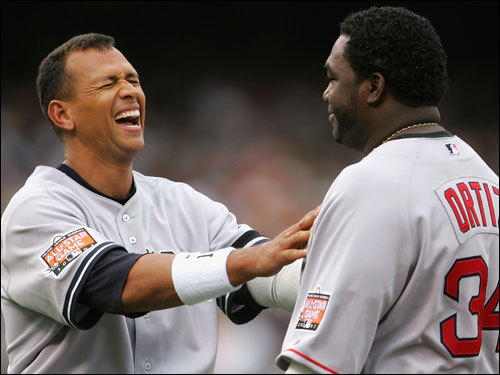
I'm a Yankee fan, and now I have to deal with the fall-out from the revelation that Alex Rodriguez took steroids--and I'll have to deal with hearing about this for the next nine years of his contract. This is especially awful because I have to share the city of New York with fans of another team who take as much, if not more, delight in the failures of the Yankees than the success of their own favorite team.

With Obama in the White House now, you'd think I could find some good news there. But the truth is that our problems are so big that nothing he does seems likely to fix them.

By far the biggest problem we face is the financial crisis (although global warming and the Middle East aren't far behind). And Obama is working on fixing our system, while what we really need is to change the system itself.

There's never a better time for radical change than during times of crisis, but it looks like the change we need is too scary to even contemplate.

And what we really need is to readjust our lenses and our appetites for the possible. (Economist Nouriel Roubini also believes our system has failed.)

But from what I see and read in the news, folks on Wall Street and in Washington still think that at some point, we're going to get back on track and that life will go on as it did before, with double-digit growth, low unemployment, and largely unregulated markets.

All we have to do is weather the storm.

But I don't think that's going to happen.

They're delusional, and unfortunately, their hallucinations can affect our reality. We need to absorb the lesson rather than pretend it's just a pop quiz in the classroom of our lives, but it looks like we're all willing to share in the common hallucination.

We need to change, but I don't see any big changes in the offing, and that too says something about our national character.

There was a time, not too long ago, when Americans were capable of reacting quickly and turning on a dime, just to try something different. Remember the Contract With America? I was no fan--I'm still not--but, especially living abroad in the land of government oversight, I was impressed with Americans' willingness to try something new, kick out the bums (even if they were Democrats) and experiment.

It seemed like a watershed event that portended a long-term shift in American politics. That was 1994, and only ten years later, Democrats were back in control of the House.

What happened in the meantime? Corporate profits and stock market returns from 1994 to 2004 grew like never before, fueled in large part by government investment in technology and basic research, and productivity gains from technology in the private sector.

For illustrative purposes, note that the Dow Jones Industrial Average was at 1132.40 in June 1984, rose to 3646.55 at the same period in 1994, and then skyrocketed to 10,416.41 in 2004.

The trough from 2001-2003 was a result of the simultaneous bursting of the tech bubble, accounting scandals that shook confidence in Wall Street, and of course 9/11.

But the Bush tax cuts and the repeal of Glass-Steagall helped fuel a new boom, this time in real estate, that allowed huge numbers of homeowners to refinance their mortgages, close the income disparity gap between themselves and the wealthy, and to fuel further double-digit corporate sales and profits growth.

And we learned to like it big in those years. In every way. We learned to love big SUVs that helped accelerate global warming (and if you still don't think this is real, please check this article); we learned to love big meals from McDonalds, big profits from big companies, big mergers and bigger banks, and big increases in house valuations.

And huge numbers of home runs from our big baseball players.

In fact, players in every sport were getting super-sized, and we ate it up. We didn't ask them to use steroids, but we sure liked the results. We loved the spectacle of 250-pound linebackers running faster than Carl Lewis and 400-foot "big-flies" (as Jon Miller loves to call them on the Sunday Night Game of the Week).

We loved huge streaks (Cal Ripken, the number of quarters of consecutive GDP growth) and huge steaks.

We got hooked on big.

I've put this in the past tense, but its still happening, of course. This is why Barack Obama can't allow Wall Street to fail massively. Our retirements are sitting in pension funds that own those Big stocks (and many of those funds have bylaws that force the fund managers to hold certain percentages of Blue Chip stocks), so the pain wouldn't just be felt on Wall Street and among the hedge fund types that few people would mind seeing flayed and flopping in the wind.

If the U.S. financial system collapses, we're all going to feel huge pain.

But despite the banking rescue and the stimulus package, I think we have changed. For one thing, I think we'll be more wary of the next Big Thing. We're going to look around and see that maybe they're not so crazy in France after all, clinging to their baguettes, their Brie, and their ancestral family homes tucked away in the Rhone Valley.

This will take some getting used-to. We're going to save more and spend less, and that's going to mean no more double-digit sales growth at the Gap; no more double-digit profits growth for the advertising sector; no more big windfalls for the day traders.

Just because superficialities like the speed of communications and the depth of knowledge have changed doesn't mean that the normal rhythms of life have changed. Seasons still require 3 months to play themselves out, we mature and we age, and we can't go back in time.

We'll find that smaller growth isn't so bad. Spending 16 hours a day in front of the computer screen won't be worth as much, so we'll probably have more time to spend with our friends and family, or watching a baseball game slowly unfold before us, probably with a lot fewer home runs than we've gotten used to.

Reblog this post [with Zemanta]

Wednesday, January 28, 2009

Stimulating Days

LAS VEGAS - OCTOBER 30:  (L-R) Actor Tony Danz...Image by Getty Images via Daylife

Cynicism is easy. Just pop in the toaster of received truths (nothing ever changes, they're all crooks, waste of taxpayer money) and wait a second.

Cynicism is easy, and it's also usually wrong. Being cynical is like doubting that the sky is blue just because it happens to be raining. (And then maintaining that it only 'looks' blue when the skies clear.)

Good things happen if you work for them and keep your eyes open.

There's a lot to like about the new stimulus bill, and probably a lot to dislike as well. What's new here is that we're getting a chance to look at the sausage-making process. We're being asked to behave like grown-ups.

Items I like include money for mass transit and assistance on energy costs to low-income Americans.

In addition to his usual admonition for people to act responsible, President Obama reiterated that his Administration will make the spending transparent to the American people.
“Corporate America will have to accept its own responsibility to workers and the American public,” Mr. Obama said, after alluding to an “atmosphere of irresponsibility” on Wall Street and in Washington that he said had helped push the economy toward ruin. He said, too, that he understands the skepticism that some people feel about the prospect of spending astronomical sums of the taxpayers’ money efficiently. Therefore, he said, his administration will put in place “unprecedented measures,” including Internet postings, to allow the American people to see where the streams of dollars are flowing.

That means not throwing up our hands in disgust, and not stamping our feet because our political opponents got something they want that we didn't. It means looking at the results and deciding whether, on balance, there's more of what we wanted and whether it's better than nothing.

So far, so good, as far as I can see.

Reblog this post [with Zemanta]

Tuesday, January 27, 2009

Give Obama Credit

US Senator Barack Obama campaigning in New Ham...Image via WikipediaA lot of people on the left are fretting that Obama is allowing the GOP to undermine his stimulus package by diluting it with tax cuts and reduced spending--before voting against it--thereby giving themselves an electoral boost in 2010 by showing they had the wisdom to vote against a loser of a plan.

In other words, Obama is letting himself get outsmarted by the Republicans because he is naive enough to think they will end him a helping hand in exchange for his magnanimous approach to governance.

Just so I'm sure we're talking about the same guy: this is the same Barack Hussein Obama who beat powerful connected, household name Senator Hillary Clinton, right? And rich-as-hell Jonathan (pre-adultery revelation) Edwards.

And who then thumped heroic war veteran and maverick John McCain. Right?

I used to make the mistake of thinking that because this guy is a panty-waist because he aims to change the culture in Washington, get beyond partisan politics, and make government more responsive to the American people.

Anyone with ideas like that has to have his head in the clouds, right? An idealist in a world of real politik. Well, shame on me and shame on us. No wonder we couldn't elect George McGovern. We didn't have the conviction of our own ideals.

Well, I think we have to give Obama credit for being a good fighter. He may be a visionary, but he's also a pragmatist. And he's surrounded himself with folks like Rahm Emanuel and Joe Biden, who have a little bit of experience in Washington in-fighting.

With respect to the stimulus package, I don't think Obama is being taken for a ride by the GOP. I think it's the other way around. He will get his stimulus package pretty much the way he wants it--because Pelosi will play bad cop to his good cop--and the Republicans will look petty for voting against it despite the concessions the press will note that they were given.

And the truth will probably be that they didn't get very many concessions Obama wasn't willing to write into the stimulus bill anyway.

This will weaken the GOP as Obama's term progresses and he gets to tougher nuts like health care and foreign policy.

Reblog this post [with Zemanta]

Wednesday, January 21, 2009

A Picture is Worth...

Well, this just says it all:


President Obama

WASHINGTON - NOVEMBER 10:   U.S. President Geo...Image by Getty Images via DaylifeSeveral commentators noted President Obama's admonition that "We reject as false the choice between our safety and our ideals."

President Obama is making a determined and laudable effort to find common ground with his political adversaries, but I was relieved to hear him draw at least that distinction between himself the previous Administration.

On a personal note, my son is a dual citizen of the U.S. and France, and he lives and goes to college in France. I'm glad that he has reason to be proud of his American heritage, and even to reexamine earlier, more bitter lessons he's had about America.

For this and many other reasons, I've been acutely aware of how the U.S. is viewed abroad. What many on the intellectual left (and even the right) don't realize about Americans is how easily we can be led to believe that everything we have achieved, we have achieved alone, and that the rest of the world is either grateful for the bounty that we bestow upon them (our economic and political way of life is the envy of all!), or else insane, ungrateful and ultimately, evil and of no account.

Populists, mostly on the right, have encouraged this kind of jingoism because it justifies our disregard for international treaties which impinge on the profits of Corporate America (think Kyoto Treaty) or which cast doubt on the legitimacy of some of our military adventures.

It will be useful to remind the public of how much we have depended on foreign powers for much of our history, and of how much we have been enriched by great individuals who came to the United States because of what we stand for... which is much more than unfettered freedom to make money.
Reblog this post [with Zemanta]

Saturday, January 17, 2009

Obama Vindicating Bush? Not Really

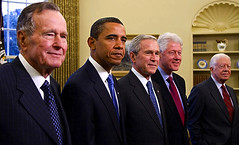
2009 Five Presidents George W. Bush, President...Image by BL1961 via FlickrCharles Krauthammer, well-known to New Yorkers for his reactionary diatribes in the paragon of reasonableness known as the New York Post, argues that outgoing President George W. Bush is being vindicated as we speak.

Never mind the campaign oratory, Krauthammer says, Barack Obama's appointments tacitly acknowledge that Bush's conduct of the war in Iraq, the condoning of the use of torture, and laissez-faire economic policy were all appropriate.

The very continuation by Democrats of Bush's policies will be grudging, if silent, acknowledgment of how much he got right.

Krauthammer says the selection of Timothy Geithner to head Treasury demonstrates Obama's approval of Bush economic policy; likewise, keeping Gates at Defense means continuity of Bush's Iraq strategy; and Obama's refusal to summarily dismiss every single one of Dick Cheney's policy suggestions means Obama now supports torture.

It's a pathetic and blatantly transparent attempt by Krauthammer to whitewash not only 8 years of disastrous policy and incompetent administraton, but by extension, 8 years of unapologetic babbling in support of those policies by one of the most unreflective and unself-critical pundits on the Washington scene (what a coincidence).

Krauthammer is conflating unrelated events to suit his theorem, but reality is more complex and, thankfully, Obama is as non-ideological as promised.

Where the selection of Geithner is concerned, Obama is choosing to continue with the implementation of a policy he supported from the beginning--in September 2008--and which is at odds with not only 8 years of Bush incompetence but more than a century of free market principles.

Geithner himself is typical of the people Obama has picked to fill his Cabinet: highly intelligent, capable, and expert in the matter at hand. Geithner is by all accounts brilliant, and because he had a hand in the bail-out, can help Obama administer it better than any outsider, especially in the short term.

Gates is hardly a Bush favorite, and went so far as to contradict Bush's statements on Iraq during his confirmation hearings in 2006. Moreover, Gates is in the middle of the kind of badly needed institutional reform at the Pentagon, and Obama has wisely decided to allow him to finish his work.

It wouldn't surprise me to see SoS Hillary Clinton and National Security Advisor James Jones have more say in policy matters than Gates--hardly a ringing endorsement of the Bush Iraq strategy.

Finally, Obama's refusal to make overly-sweeping statements does nothing to diminish his firm statements about our use of torture and the need for America to earn back the respect of the community of nations.

If by rehabilitating Bush, Krauthammer means that Obama will close the Guantanamo prison, end our policy of extraordinary rendition, move our troops out of Iraq in as orderly and rapid manner as possible, step up the war on the Taliban in Afghanistan and Pakistan, and replace unprovoked war with diplomacy as the primary instrument of foreign policy, then I guess we can call that a vindication.

If by rehabilitating Bush, Krauthammer means spending on public works programs, extending unemployment benefits, creating a national health insurance program and reaffirming the role of proactive government in American life is vindication of Bush politics, then I guess we can call that a vindication.

After all, historian Ferdinand Braudel credits the excesses of feudalism with paving the way for capitalism, so in a way, the excessive incompetence of George Bush's "Administration" can certainly be seen as paving the way for a return to progressive American politics.


Reblog this post [with Zemanta]

Thursday, January 15, 2009

Obama Meets Reactionaries Without Preconditions

Image via WikipediaPresident-elect Barack Obama accepted George Will's invitation to break bread, and supped with Will and fellow reactionary columnists Bill Kristol, David Brooks and Charles Krauthammer.

Obama apparently came to dinner without having first extracted promises that the reactionaries would share Obama's convictions, recant past positions, retract previous defamatory and patently untrue remarks, or even agree to disagree.

However, that Obama should agree to sit down with these enemies of civil liberties, coddlers of torturers and defenders of despoilers of American treasure should come as no surprise, given his campaign promises.

Reached for comment, New York Senator Charles Schumer said, "I for one am appalled. We expected 'that one' to meet with Kim Jong Il or Pol Pot or someone like that. But these guys? It's beyond incredible."

However, true to his word, Obama is reaching out to friends and foe alike, no matter how irrational they may seem.

Reblog this post [with Zemanta]

Tuesday, January 13, 2009

Obama Should Follow Spirit, Not Letter

Barack Obama Elected PresidentImage by jvoves via Flickr

New York-based VC Fred Wilson makes an excellet point about the details of Obama's economic fix-it plan versus the stated purpose of Obama's candidacy.

He argues that Obama's leadership is more important than the fine print of the stimulus program, especially given that the economic models that everyone is using are likely to be anachronistic.
I had dinner last night with some friends, all of whom were big supporters of Obama and his vision of change. All of us were at least a little (and in some cases a lot) concerned that in the transition from candidate to President, Obama was getting sucked into conventional thinking. Spending a trillion dollars may work, but helping change the DNA of america and the world would help a lot more. And he doesn't need economists to tell him how to do that.
Reblog this post [with Zemanta]

Monday, January 5, 2009

Stimulate, Don't Imitate

Here is the text of a comment I left on Change.gov. President Obama needs to pass the stimulus package as he thinks it should be constructed, and not with a view to placating the GOP by imitating their failed policies.

Please stop meeting the GOP halfway before they demonstrate a willingness to meet you halfway as well. We won the election by being faithful to our progressive beliefs, and the country voted for those principles. We as a people have rejected laissez-faire and tax-cutting economics and we want a real stimulus package. It seems like you are bending over backwards to negotiate when you should be dealing from a position of strength. The GOP is not going to play nice. They would rather see you fail, even if it means more pain for the American people.
If the GOP attempts to filibuster your plan, call on the American people to email their reps; that will give you all the political capital you need.
I agree that you should try to build consensus around long-range programs so that they have a chance to stick around past your Administration, but this stimulus package is short-term and should be the best proposal you think you can put forward, not a compromised version you hope will please the GOP.
We elected a progressive government on purpose, and we deserve the government we worked to get. Please remember that you owe your election to the people, and we need you to fulfill the mandate you were elected to enact, not earn brownie points with Mitch McConnell.