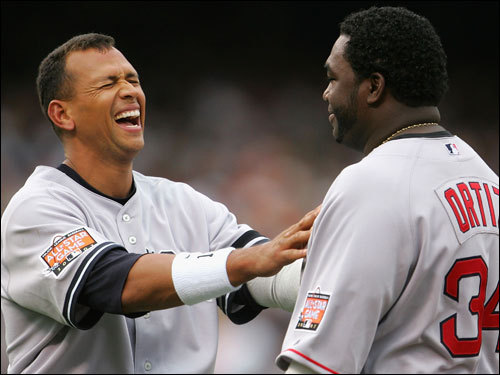
 Image via Wikipedia
It occurred to me this morning, while I was pumping iron at the gym in the hopes that giant muscles would compensate for my burgeoning gut, that my usual refuge from bad news is gone.
See, I'm not someone who can just ignore the news--I make my living from it. But what I usually do is, if news is bad on the political front, I just focus on sports. (And one of the benefits of living in New York is that there's always a professional or college sports team playing well enough to captivate our collective attention.) If sports news is bad (i.e., the Yankees lost a game), I can turn to politics (and again, living in New York, there's no shortage of politics, and I know I'll be able to find some liberal cause or other that won some kind of victory worth celebrating.)
It's not a big thing, this temporary respite from reality. It's just like my brain needs a spot of shade from the oppressive glare and heat of bad news.
I'm a Yankee fan, and now I have to deal with the fall-out from the revelation that Alex Rodriguez took steroids--and I'll have to deal with hearing about this for the next nine years of his contract. This is especially awful because I have to share the city of New York with fans of another team who take as much, if not more, delight in the failures of the Yankees than the success of their own favorite team.
With Obama in the White House now, you'd think I could find some good news there. But the truth is that our problems are so big that nothing he does seems likely to fix them.
By far the biggest problem we face is the financial crisis (although global warming and the Middle East aren't far behind). And Obama is working on fixing our system, while what we really need is to change the system itself.
There's never a better time for radical change than during times of crisis, but it looks like the change we need is too scary to even contemplate.
And what we really need is to readjust our lenses and our appetites for the possible. (Economist Nouriel Roubini also believes our system has failed.)
But from what I see and read in the news, folks on Wall Street and in Washington still think that at some point, we're going to get back on track and that life will go on as it did before, with double-digit growth, low unemployment, and largely unregulated markets.
All we have to do is weather the storm.
But I don't think that's going to happen.
They're delusional, and unfortunately, their hallucinations can affect our reality. We need to absorb the lesson rather than pretend it's just a pop quiz in the classroom of our lives, but it looks like we're all willing to share in the common hallucination.
We need to change, but I don't see any big changes in the offing, and that too says something about our national character.
There was a time, not too long ago, when Americans were capable of reacting quickly and turning on a dime, just to try something different. Remember the Contract With America? I was no fan--I'm still not--but, especially living abroad in the land of government oversight, I was impressed with Americans' willingness to try something new, kick out the bums (even if they were Democrats) and experiment.
It seemed like a watershed event that portended a long-term shift in American politics. That was 1994, and only ten years later, Democrats were back in control of the House.
What happened in the meantime? Corporate profits and stock market returns from 1994 to 2004 grew like never before, fueled in large part by government investment in technology and basic research, and productivity gains from technology in the private sector.
For illustrative purposes, note that the Dow Jones Industrial Average was at 1132.40 in June 1984, rose to 3646.55 at the same period in 1994, and then skyrocketed to 10,416.41 in 2004.
The trough from 2001-2003 was a result of the simultaneous bursting of the tech bubble, accounting scandals that shook confidence in Wall Street, and of course 9/11.
But the Bush tax cuts and the repeal of Glass-Steagall helped fuel a new boom, this time in real estate, that allowed huge numbers of homeowners to refinance their mortgages, close the income disparity gap between themselves and the wealthy, and to fuel further double-digit corporate sales and profits growth.
And we learned to like it big in those years. In every way. We learned to love big SUVs that helped accelerate global warming (and if you still don't think this is real, please check this article); we learned to love big meals from McDonalds, big profits from big companies, big mergers and bigger banks, and big increases in house valuations.
And huge numbers of home runs from our big baseball players.
In fact, players in every sport were getting super-sized, and we ate it up. We didn't ask them to use steroids, but we sure liked the results. We loved the spectacle of 250-pound linebackers running faster than Carl Lewis and 400-foot "big-flies" (as Jon Miller loves to call them on the Sunday Night Game of the Week).
We loved huge streaks (Cal Ripken, the number of quarters of consecutive GDP growth) and huge steaks.
We got hooked on big.
I've put this in the past tense, but its still happening, of course. This is why Barack Obama can't allow Wall Street to fail massively. Our retirements are sitting in pension funds that own those Big stocks (and many of those funds have bylaws that force the fund managers to hold certain percentages of Blue Chip stocks), so the pain wouldn't just be felt on Wall Street and among the hedge fund types that few people would mind seeing flayed and flopping in the wind.
If the U.S. financial system collapses, we're all going to feel huge pain.
But despite the banking rescue and the stimulus package, I think we have changed. For one thing, I think we'll be more wary of the next Big Thing. We're going to look around and see that maybe they're not so crazy in France after all, clinging to their baguettes, their Brie, and their ancestral family homes tucked away in the Rhone Valley.
This will take some getting used-to. We're going to save more and spend less, and that's going to mean no more double-digit sales growth at the Gap; no more double-digit profits growth for the advertising sector; no more big windfalls for the day traders.
Just because superficialities like the speed of communications and the depth of knowledge have changed doesn't mean that the normal rhythms of life have changed. Seasons still require 3 months to play themselves out, we mature and we age, and we can't go back in time.
We'll find that smaller growth isn't so bad. Spending 16 hours a day in front of the computer screen won't be worth as much, so we'll probably have more time to spend with our friends and family, or watching a baseball game slowly unfold before us, probably with a lot fewer home runs than we've gotten used to.
![Reblog this post [with Zemanta]](http://img.zemanta.com/reblog_e.png?x-id=06b52174-f41d-4dac-9d0a-471cef440a8a)


No comments:
Post a Comment