Tuesday, March 10, 2009

Congress Reasserting Itself At Obama's Expense

I have mixed feelings about this, but overall it's a good thing to see Congress reassert its role as a check on the president's power.

For the past eight years, under the Bush Administration, Congress bowed to the "war-time President" under the false premise that dissent was equivalent to disloyalty.

As a result, we have gone to war unwisely and spent trillions of dollars we could really use now--and in fact one could argue that we may not be in the current straits were it not for a feckless and ineffective White House.

Congress should never abnegate its responsibilities again.

Which brings me to Warren Buffet's recent remarks, to the effect that both democrats and republicans should stand behind Obama. There is nothing a-political or post-partisan about budgets.

I think Obama has been misunderstood when he talks about post-partisanship. He doesn't mean a lack of disagreement or defined political principles.

What he means is an end to automatically disagreeing with someone because they belong to the opposing party. It means listening to arguments with an open mind and expecting to agree rather than not.

It won't be easy for Obama to accomplish this, but we elected him because we think he can be more effective than anyone else. Now it's up to him to define post-partisanship and to lead by example.

The fact that this won't happen overnight is proof that he's not "Barack the magic negro." But we didn't elect him for his magical powers. We elected him because he's good at what he does.

He's accomplished a great deal so far in his not-quite-2-month-old Administration, and unfortunately, we need a lot more from him. Congress isn't making it easy for him, and as much as part of me would like them to just roll over and obey him, I'm glad that they're not.


Sunday, February 15, 2009

New Rules for a New Era?

Factors contributing to someone's credit score...Image via Wikipedia

I thought I was being smart by cutting down on my credit card use. I even stopped using one of them at all. I aid my HSBC card all the way down but kept the account active, just like Suze Ormond suggests.

So imagine my surprise when HSBC summarily canceled my account due to inactivity. Da noive a dem bums!

But HSBC's actions are part of a larger trend, with most credit providers culling inactive accounts from their ranks in order to reduce expenses and the risk of fraud.

It's more than blow to your ego, however--it's also a blow to your credit score. When an account is closed, your total available credit goes down with it, thus worsening your credit utilization ratio.

Your credit utilization ratio -- the amount of your debt in relation to the amount of your available credit -- comprises 30% of your score, says Craig Watts, a spokesman for Fair Isaac Corporation (FIC), the company that calculates and issues the FICO credit score that most lenders use. So when an account is closed, you have less credit available to you -- and the ratio immediately jumps higher. A person with a solid credit score of 720 or so, whose utilization ratio jumps from 35% to 75% after one of their accounts is closed is likely see their score drop by "several dozen points," to somewhere in the 600s, he says. That's a far cry from the 760 (or higher) consumers need to get the best rates from lenders.

Of course, credit card companies are not open to negotiation. All they will tell you is that you're free to re-apply for a credit card. But that's cold comfort if your score makes you unworthy -- thanks to their actions no less.

Lenders have too much power in our system for consumers to be able to fend for themselves. And a good credit score is critical to everything from buying a new suit to renting an apartment in a big city.

Which is why, with so much of the economy being driven by consumer spending, and consumer spending so closely tied to credit, the federal government should step in and tip the scale in favor of consumers.

A couple of things might help:
  • prohibit credit card issuers from raising rates on pre-existing balances. If they want to raise rates going forward, fine. But the same rules should apply for buying a PC with a card as do for buying a car through GMAC. The rate I get is the rate I pay for the term of the loan;
  • prohibit issues from closing accounts due to inactivity, unless those terms are stipulated in the initial contract, and are made clear from the get-go. No fine print excuses allowable. And issuers have to warn consumers if such an action is imminent.
  • Stop issuers from raising rates because of a consumer's actions on other cards. I shouldn't be punished by an issuer that I haven't harmed.

Now that's one way to reignite consumer confidence for the long haul.

Saturday, February 14, 2009

What to do About That 401(k)

WASHINGTON - OCTOBER 15:  Save Darfur activist...Image by Getty Images

I decided to bite the bullet and look at the statement that Fidelity had the nerve/sadistic impulse/customer-friendly approach (pick one that best applies) to make available yesterday.

Ouch. I lost money last quarter and I lost money again in January. I don't feel like saying how much, but let's just say it was a little under 10%.

The problem is that I haven't changed my allocations since the end of Q3, and that's just not smart; a lot has changed since September. Because I'm still (relatively) young, I have a lot in growth stocks, a decent amount in small caps and international funds, a bit in value funds and the rest in treasuries.

I realize that I should reallocate, but the fact is that I just don't feel like it. I don't want to think about it. It depresses me, and I'm not even sure how to go about doing that now. What's a good strategy in the current environment?

The truth is, there aren't a lot of answers out there, simply because no one trusts anything. Tim Middleton has some interesting ideas for investing retirement funds during a recession, including one--save less--that makes sense, even if it is counter-intuitive.

The one thing we shouldn't do, however, is what I've been guilty of doing--which is hiding my head in the sand. The news can't get much worse, and I'll probably feel better by doing something instead of trying -- and failing -- to forget about it.

Monday, February 9, 2009

American Gigantism: Big Bad News

Same as :en::Image:DJIA historical graph.svg, ...Image via Wikipedia

It occurred to me this morning, while I was pumping iron at the gym in the hopes that giant muscles would compensate for my burgeoning gut, that my usual refuge from bad news is gone.

See, I'm not someone who can just ignore the news--I make my living from it. But what I usually do is, if news is bad on the political front, I just focus on sports. (And one of the benefits of living in New York is that there's always a professional or college sports team playing well enough to captivate our collective attention.) If sports news is bad (i.e., the Yankees lost a game), I can turn to politics (and again, living in New York, there's no shortage of politics, and I know I'll be able to find some liberal cause or other that won some kind of victory worth celebrating.)

It's not a big thing, this temporary respite from reality. It's just like my brain needs a spot of shade from the oppressive glare and heat of bad news.

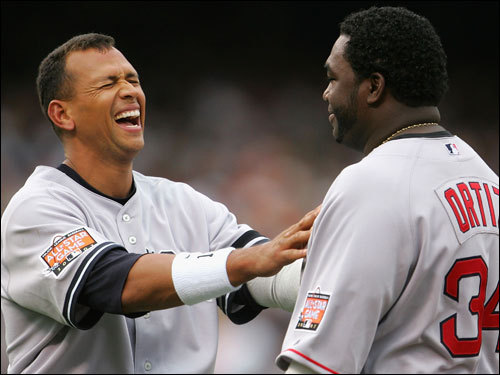
I'm a Yankee fan, and now I have to deal with the fall-out from the revelation that Alex Rodriguez took steroids--and I'll have to deal with hearing about this for the next nine years of his contract. This is especially awful because I have to share the city of New York with fans of another team who take as much, if not more, delight in the failures of the Yankees than the success of their own favorite team.

With Obama in the White House now, you'd think I could find some good news there. But the truth is that our problems are so big that nothing he does seems likely to fix them.

By far the biggest problem we face is the financial crisis (although global warming and the Middle East aren't far behind). And Obama is working on fixing our system, while what we really need is to change the system itself.

There's never a better time for radical change than during times of crisis, but it looks like the change we need is too scary to even contemplate.

And what we really need is to readjust our lenses and our appetites for the possible. (Economist Nouriel Roubini also believes our system has failed.)

But from what I see and read in the news, folks on Wall Street and in Washington still think that at some point, we're going to get back on track and that life will go on as it did before, with double-digit growth, low unemployment, and largely unregulated markets.

All we have to do is weather the storm.

But I don't think that's going to happen.

They're delusional, and unfortunately, their hallucinations can affect our reality. We need to absorb the lesson rather than pretend it's just a pop quiz in the classroom of our lives, but it looks like we're all willing to share in the common hallucination.

We need to change, but I don't see any big changes in the offing, and that too says something about our national character.

There was a time, not too long ago, when Americans were capable of reacting quickly and turning on a dime, just to try something different. Remember the Contract With America? I was no fan--I'm still not--but, especially living abroad in the land of government oversight, I was impressed with Americans' willingness to try something new, kick out the bums (even if they were Democrats) and experiment.

It seemed like a watershed event that portended a long-term shift in American politics. That was 1994, and only ten years later, Democrats were back in control of the House.

What happened in the meantime? Corporate profits and stock market returns from 1994 to 2004 grew like never before, fueled in large part by government investment in technology and basic research, and productivity gains from technology in the private sector.

For illustrative purposes, note that the Dow Jones Industrial Average was at 1132.40 in June 1984, rose to 3646.55 at the same period in 1994, and then skyrocketed to 10,416.41 in 2004.

The trough from 2001-2003 was a result of the simultaneous bursting of the tech bubble, accounting scandals that shook confidence in Wall Street, and of course 9/11.

But the Bush tax cuts and the repeal of Glass-Steagall helped fuel a new boom, this time in real estate, that allowed huge numbers of homeowners to refinance their mortgages, close the income disparity gap between themselves and the wealthy, and to fuel further double-digit corporate sales and profits growth.

And we learned to like it big in those years. In every way. We learned to love big SUVs that helped accelerate global warming (and if you still don't think this is real, please check this article); we learned to love big meals from McDonalds, big profits from big companies, big mergers and bigger banks, and big increases in house valuations.

And huge numbers of home runs from our big baseball players.

In fact, players in every sport were getting super-sized, and we ate it up. We didn't ask them to use steroids, but we sure liked the results. We loved the spectacle of 250-pound linebackers running faster than Carl Lewis and 400-foot "big-flies" (as Jon Miller loves to call them on the Sunday Night Game of the Week).

We loved huge streaks (Cal Ripken, the number of quarters of consecutive GDP growth) and huge steaks.

We got hooked on big.

I've put this in the past tense, but its still happening, of course. This is why Barack Obama can't allow Wall Street to fail massively. Our retirements are sitting in pension funds that own those Big stocks (and many of those funds have bylaws that force the fund managers to hold certain percentages of Blue Chip stocks), so the pain wouldn't just be felt on Wall Street and among the hedge fund types that few people would mind seeing flayed and flopping in the wind.

If the U.S. financial system collapses, we're all going to feel huge pain.

But despite the banking rescue and the stimulus package, I think we have changed. For one thing, I think we'll be more wary of the next Big Thing. We're going to look around and see that maybe they're not so crazy in France after all, clinging to their baguettes, their Brie, and their ancestral family homes tucked away in the Rhone Valley.

This will take some getting used-to. We're going to save more and spend less, and that's going to mean no more double-digit sales growth at the Gap; no more double-digit profits growth for the advertising sector; no more big windfalls for the day traders.

Just because superficialities like the speed of communications and the depth of knowledge have changed doesn't mean that the normal rhythms of life have changed. Seasons still require 3 months to play themselves out, we mature and we age, and we can't go back in time.

We'll find that smaller growth isn't so bad. Spending 16 hours a day in front of the computer screen won't be worth as much, so we'll probably have more time to spend with our friends and family, or watching a baseball game slowly unfold before us, probably with a lot fewer home runs than we've gotten used to.

Reblog this post [with Zemanta]

Wednesday, January 28, 2009

Stimulating Days

LAS VEGAS - OCTOBER 30:  (L-R) Actor Tony Danz...Image by Getty Images via Daylife

Cynicism is easy. Just pop in the toaster of received truths (nothing ever changes, they're all crooks, waste of taxpayer money) and wait a second.

Cynicism is easy, and it's also usually wrong. Being cynical is like doubting that the sky is blue just because it happens to be raining. (And then maintaining that it only 'looks' blue when the skies clear.)

Good things happen if you work for them and keep your eyes open.

There's a lot to like about the new stimulus bill, and probably a lot to dislike as well. What's new here is that we're getting a chance to look at the sausage-making process. We're being asked to behave like grown-ups.

Items I like include money for mass transit and assistance on energy costs to low-income Americans.

In addition to his usual admonition for people to act responsible, President Obama reiterated that his Administration will make the spending transparent to the American people.
“Corporate America will have to accept its own responsibility to workers and the American public,” Mr. Obama said, after alluding to an “atmosphere of irresponsibility” on Wall Street and in Washington that he said had helped push the economy toward ruin. He said, too, that he understands the skepticism that some people feel about the prospect of spending astronomical sums of the taxpayers’ money efficiently. Therefore, he said, his administration will put in place “unprecedented measures,” including Internet postings, to allow the American people to see where the streams of dollars are flowing.

That means not throwing up our hands in disgust, and not stamping our feet because our political opponents got something they want that we didn't. It means looking at the results and deciding whether, on balance, there's more of what we wanted and whether it's better than nothing.

So far, so good, as far as I can see.

Reblog this post [with Zemanta]

Tuesday, January 27, 2009

Give Obama Credit

US Senator Barack Obama campaigning in New Ham...Image via WikipediaA lot of people on the left are fretting that Obama is allowing the GOP to undermine his stimulus package by diluting it with tax cuts and reduced spending--before voting against it--thereby giving themselves an electoral boost in 2010 by showing they had the wisdom to vote against a loser of a plan.

In other words, Obama is letting himself get outsmarted by the Republicans because he is naive enough to think they will end him a helping hand in exchange for his magnanimous approach to governance.

Just so I'm sure we're talking about the same guy: this is the same Barack Hussein Obama who beat powerful connected, household name Senator Hillary Clinton, right? And rich-as-hell Jonathan (pre-adultery revelation) Edwards.

And who then thumped heroic war veteran and maverick John McCain. Right?

I used to make the mistake of thinking that because this guy is a panty-waist because he aims to change the culture in Washington, get beyond partisan politics, and make government more responsive to the American people.

Anyone with ideas like that has to have his head in the clouds, right? An idealist in a world of real politik. Well, shame on me and shame on us. No wonder we couldn't elect George McGovern. We didn't have the conviction of our own ideals.

Well, I think we have to give Obama credit for being a good fighter. He may be a visionary, but he's also a pragmatist. And he's surrounded himself with folks like Rahm Emanuel and Joe Biden, who have a little bit of experience in Washington in-fighting.

With respect to the stimulus package, I don't think Obama is being taken for a ride by the GOP. I think it's the other way around. He will get his stimulus package pretty much the way he wants it--because Pelosi will play bad cop to his good cop--and the Republicans will look petty for voting against it despite the concessions the press will note that they were given.

And the truth will probably be that they didn't get very many concessions Obama wasn't willing to write into the stimulus bill anyway.

This will weaken the GOP as Obama's term progresses and he gets to tougher nuts like health care and foreign policy.

Reblog this post [with Zemanta]

Wednesday, January 21, 2009

A Picture is Worth...

Well, this just says it all:


President Obama

WASHINGTON - NOVEMBER 10:   U.S. President Geo...Image by Getty Images via DaylifeSeveral commentators noted President Obama's admonition that "We reject as false the choice between our safety and our ideals."

President Obama is making a determined and laudable effort to find common ground with his political adversaries, but I was relieved to hear him draw at least that distinction between himself the previous Administration.

On a personal note, my son is a dual citizen of the U.S. and France, and he lives and goes to college in France. I'm glad that he has reason to be proud of his American heritage, and even to reexamine earlier, more bitter lessons he's had about America.

For this and many other reasons, I've been acutely aware of how the U.S. is viewed abroad. What many on the intellectual left (and even the right) don't realize about Americans is how easily we can be led to believe that everything we have achieved, we have achieved alone, and that the rest of the world is either grateful for the bounty that we bestow upon them (our economic and political way of life is the envy of all!), or else insane, ungrateful and ultimately, evil and of no account.

Populists, mostly on the right, have encouraged this kind of jingoism because it justifies our disregard for international treaties which impinge on the profits of Corporate America (think Kyoto Treaty) or which cast doubt on the legitimacy of some of our military adventures.

It will be useful to remind the public of how much we have depended on foreign powers for much of our history, and of how much we have been enriched by great individuals who came to the United States because of what we stand for... which is much more than unfettered freedom to make money.
Reblog this post [with Zemanta]

Saturday, January 17, 2009

Obama Vindicating Bush? Not Really

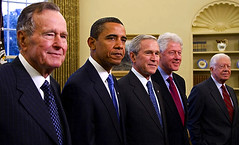
2009 Five Presidents George W. Bush, President...Image by BL1961 via FlickrCharles Krauthammer, well-known to New Yorkers for his reactionary diatribes in the paragon of reasonableness known as the New York Post, argues that outgoing President George W. Bush is being vindicated as we speak.

Never mind the campaign oratory, Krauthammer says, Barack Obama's appointments tacitly acknowledge that Bush's conduct of the war in Iraq, the condoning of the use of torture, and laissez-faire economic policy were all appropriate.

The very continuation by Democrats of Bush's policies will be grudging, if silent, acknowledgment of how much he got right.

Krauthammer says the selection of Timothy Geithner to head Treasury demonstrates Obama's approval of Bush economic policy; likewise, keeping Gates at Defense means continuity of Bush's Iraq strategy; and Obama's refusal to summarily dismiss every single one of Dick Cheney's policy suggestions means Obama now supports torture.

It's a pathetic and blatantly transparent attempt by Krauthammer to whitewash not only 8 years of disastrous policy and incompetent administraton, but by extension, 8 years of unapologetic babbling in support of those policies by one of the most unreflective and unself-critical pundits on the Washington scene (what a coincidence).

Krauthammer is conflating unrelated events to suit his theorem, but reality is more complex and, thankfully, Obama is as non-ideological as promised.

Where the selection of Geithner is concerned, Obama is choosing to continue with the implementation of a policy he supported from the beginning--in September 2008--and which is at odds with not only 8 years of Bush incompetence but more than a century of free market principles.

Geithner himself is typical of the people Obama has picked to fill his Cabinet: highly intelligent, capable, and expert in the matter at hand. Geithner is by all accounts brilliant, and because he had a hand in the bail-out, can help Obama administer it better than any outsider, especially in the short term.

Gates is hardly a Bush favorite, and went so far as to contradict Bush's statements on Iraq during his confirmation hearings in 2006. Moreover, Gates is in the middle of the kind of badly needed institutional reform at the Pentagon, and Obama has wisely decided to allow him to finish his work.

It wouldn't surprise me to see SoS Hillary Clinton and National Security Advisor James Jones have more say in policy matters than Gates--hardly a ringing endorsement of the Bush Iraq strategy.

Finally, Obama's refusal to make overly-sweeping statements does nothing to diminish his firm statements about our use of torture and the need for America to earn back the respect of the community of nations.

If by rehabilitating Bush, Krauthammer means that Obama will close the Guantanamo prison, end our policy of extraordinary rendition, move our troops out of Iraq in as orderly and rapid manner as possible, step up the war on the Taliban in Afghanistan and Pakistan, and replace unprovoked war with diplomacy as the primary instrument of foreign policy, then I guess we can call that a vindication.

If by rehabilitating Bush, Krauthammer means spending on public works programs, extending unemployment benefits, creating a national health insurance program and reaffirming the role of proactive government in American life is vindication of Bush politics, then I guess we can call that a vindication.

After all, historian Ferdinand Braudel credits the excesses of feudalism with paving the way for capitalism, so in a way, the excessive incompetence of George Bush's "Administration" can certainly be seen as paving the way for a return to progressive American politics.


Reblog this post [with Zemanta]

Thursday, January 15, 2009

Obama Meets Reactionaries Without Preconditions

Image via WikipediaPresident-elect Barack Obama accepted George Will's invitation to break bread, and supped with Will and fellow reactionary columnists Bill Kristol, David Brooks and Charles Krauthammer.

Obama apparently came to dinner without having first extracted promises that the reactionaries would share Obama's convictions, recant past positions, retract previous defamatory and patently untrue remarks, or even agree to disagree.

However, that Obama should agree to sit down with these enemies of civil liberties, coddlers of torturers and defenders of despoilers of American treasure should come as no surprise, given his campaign promises.

Reached for comment, New York Senator Charles Schumer said, "I for one am appalled. We expected 'that one' to meet with Kim Jong Il or Pol Pot or someone like that. But these guys? It's beyond incredible."

However, true to his word, Obama is reaching out to friends and foe alike, no matter how irrational they may seem.

Reblog this post [with Zemanta]

Tuesday, January 13, 2009

Obama Should Follow Spirit, Not Letter

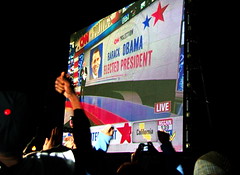
Barack Obama Elected PresidentImage by jvoves via Flickr

New York-based VC Fred Wilson makes an excellet point about the details of Obama's economic fix-it plan versus the stated purpose of Obama's candidacy.

He argues that Obama's leadership is more important than the fine print of the stimulus program, especially given that the economic models that everyone is using are likely to be anachronistic.
I had dinner last night with some friends, all of whom were big supporters of Obama and his vision of change. All of us were at least a little (and in some cases a lot) concerned that in the transition from candidate to President, Obama was getting sucked into conventional thinking. Spending a trillion dollars may work, but helping change the DNA of america and the world would help a lot more. And he doesn't need economists to tell him how to do that.
Reblog this post [with Zemanta]

Monday, January 5, 2009

Stimulate, Don't Imitate

Here is the text of a comment I left on Change.gov. President Obama needs to pass the stimulus package as he thinks it should be constructed, and not with a view to placating the GOP by imitating their failed policies.

Please stop meeting the GOP halfway before they demonstrate a willingness to meet you halfway as well. We won the election by being faithful to our progressive beliefs, and the country voted for those principles. We as a people have rejected laissez-faire and tax-cutting economics and we want a real stimulus package. It seems like you are bending over backwards to negotiate when you should be dealing from a position of strength. The GOP is not going to play nice. They would rather see you fail, even if it means more pain for the American people.
If the GOP attempts to filibuster your plan, call on the American people to email their reps; that will give you all the political capital you need.
I agree that you should try to build consensus around long-range programs so that they have a chance to stick around past your Administration, but this stimulus package is short-term and should be the best proposal you think you can put forward, not a compromised version you hope will please the GOP.
We elected a progressive government on purpose, and we deserve the government we worked to get. Please remember that you owe your election to the people, and we need you to fulfill the mandate you were elected to enact, not earn brownie points with Mitch McConnell.

Friday, January 2, 2009

Pre-Inauguration Hysteria

Bob Gates.

Lawrence Summers.

Rick Warren.

Obama's picks for various positions within his administration have created much to-do among the politically active, especially online, much of it of the hand-wringing variety. The most sympathetic summary of these Jeremiads that I can dredge up is that, given the size of Obama's victory, it's all well and good to meet the other guys half-way--but where is the proof that the other guys have any intention of meeting us half-way?

In principle, I agree that these picks (and a few others--these are just three that stand out) are disappointing in some way. Gates looks like an admission that only Republicans can handle national defense; Summers hasn't given any indication that he understands how the policies he heped craft are part of the problem; Rick Warren is a bigot.

But to cavil about these things--and yes, I'm intentionally demeaning the complainers here--is to be not only short-sighted, but to miss the whole point of Obama's campaign and subsequent election.

He's not going to do stuff we all agree with. Philosophically, he's not nearly as liberal as most progressives wish him to be, he's a bit moralistic, and above all, a shrewd and pragmatic politician.

There are 18 days left until Obama's Inauguration, followed by at least four years of sane governance by competent people. Regardless of what you think or fear about his appointments, you can take comfort that at the very least, a culture of competence will be returned to government, as well as a belief in the benefits of government activity.

Paterson's Predilections

Sometime in the next 45 days, New York State will have a new Senator, and it says here that Andrew Cuomo will be the one holding an Acela ticket to Washington.

There are a lot of good reasons, most of them inside-baseball political, for Paterson to name Caroline Kennedy. She's got ties to Obama, which is good. And she's a pick that will anger everyone, and thus no one.

See, Paterson's first goal has to be to name someone who will be able to keep it in Democratic hands in 2010.

Given the utter paucity of GOP talent in the state, it would be ludicrous for New York to elect a Republican to the Senate in 2010, but a misstep by Paterson could well bring about this result. And you can bet that the national GOP will spend heavily if they sniff the chance of embarassing the Democrats by picking off a seat in a blue state.

(New York is fairly reliably blue in presidential elections, but has been unpredictable at the state level. The GOP and Democratic parties have alternated occupancy of the governor's mansion and have seen GOPers like Alphonse D'amato, Christopher Buckley and Jacob Javitz elected to the U.S. Senate.)

Paterson's choices include:

  • Kennedy, who has name recognition and fundraising prowess, and, as a female, will at least please one constituent bloc, but whose nomination will stoke anti-entitlement passions;
  • Congresswoman Nydia Vazquez, also a female, whose nomination would satisfy Latinos angry at being underrepresented in the higher levels of state government;
  • Jerrold Nadler, a staunchly liberal congressman from the Upper West Side;
  • Byron Brown, the first African-Ameircan to be elected mayor of Buffalo; and
  • Carolyn Maloney, a long-time representative from Queens.
The problem with all of these choices, other than Brown, is that they are downstaters with little chance of carrying the entire state, particularly if faced with a potent Republican like Peter King. Moreover, Nadler is far too liberal and Vazquez an unknown minority with little pull outside NYC.

And as I mentioned above, there will be a populist backlash against Kennedy, maybe even from within her own party, with factions forcing her into a nomination fight on the grounds that she should have to face friendly fire before confronting an actual adversary in the general election.

Conversely, Brown is unknown outside Buffalo.

Andrew Cuomo, on the other hand, is well-known both upstate and down. He doesn't satisfy any particular constituency, but neither does he satisfy one at the expense of the others. And he's the member of a political family.

And while Kennedy's dynastic connection is as much a liability as it is a boost to her career, Cuomo's family name only burnishes a career and public personna he has built up on his own. Best of all for Paterson, it removes the only serious competition he might have had for his own job in 2010.

And lest we forget, Paterson doesn't come out of nowhere either. His father was Basil Paterson, a highly regarded politician who came close to being the first African-American mayor of New York City.

So Paterson knows first-hand that being the scion of a political family has built-in advantages, and a Cuomo has less baggage to tote around than a Kennedy.